Theorem (Taylor’s Theorem). Let f be analytic on B_R(z_0). Then, f has a power series representation on B_R(z_0) for |z-z_0|<R as f(z) = \sum_{n=0}^\infty a_n(z-z_0)^n\quad \text{where}\quad a_n = \frac{f^{(n)}(z_0)}{n!}. Note that this is an incredibly powerful statement; unlike \mathbb R, the function is given by the power series. However, the analytic condition is very restrictive.
For the case of z_0=0, this is called the Maclaurin series.
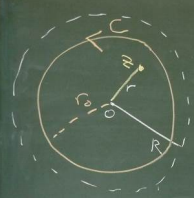
Example: What is the Maclaurin series of f(z) = e^z? f is entire which means that R=\infty. Also, f^{(n)}(0) = e^0=1 for all n. Thus, e^z = \sum_{n=0}^\infty \frac {z^n}{n!}. Proof. Assume z_0 = 0, otherwise translate. Choose z \in B_R, let |z|=r and fix r_0 \in (r, R). Set C = C_{r_0}, positively oriented.
Cauchy integral formula tells us that the value of this analytic function at z is just \begin{aligned} f(z) &= \frac 1 {2\pi i}\int_C \frac{f(\xi)}{\xi-z}\,d\xi. \end{aligned} Looking at the integrand, \begin{aligned} \frac 1 {\xi-z} &= \frac 1 \xi \left(\frac 1 {1-z/\xi}\right) \\ &= \frac 1 \xi \left(\sum_{n=0}^{N-1}(z/\xi)^n + \frac{(z/\xi)^N}{1-z/\xi}\right) \\ &= \sum_{n=0}^{N-1}\frac {z^n}{\xi^{n+1}} + \frac{z^N}{(\xi-z)\xi^N} \end{aligned} The integral becomes \begin{aligned} f(z) &= \frac 1 {2\pi i}\int_C \frac{f(\xi)}{\xi-z}\,d\xi = \sum_{n=0}^{N-1}\frac 1{2\pi i}\int_C \frac{f(\xi)z^n}{\xi^{n+1}}\,d\xi + \underbrace{\frac{z^N}{2\pi i} \int_C \frac{f(\xi)}{(\xi-z)\xi^N}\,d\xi}_{\rho_{N-1}(z)} \end{aligned} We call the rightmost part \rho_{N-1}(z). We can use Cauchy’s integral formula along with the extended Cauchy integral formula (which gives us derivatives), we get f(z) = \sum_{n=0}^{N-1}\frac{f^{(n)}(0)z^n}{n!} + \rho_{N-1}(z).
At this point, we’d like to show that \lim_{N \to \infty}\rho_{N-1}(z) = 0. Note that \xi \in C \implies |\xi| = r_0. Suppose there exists M_N such that we can bound the integrand with \left|\frac{f(\xi)}{(\xi-z)\xi^N}\right| \le M_N \quad \text{on }C. Then, we would be able to say |\rho_{N-1}(z)| \le \frac{r^N}{2\pi}M_N \ell(C) = r_0r^N M_N. To find such an M_N, f is analytic implies |f| is continuous. C is closed and bounded, so extreme value theorem (even just of a single parameter along the curve) implies there exists \mu such that |f| \le \mu on C. Furthermore, |\xi|^N = r_0^N. Using reverse triangle inequality, |\xi-z| \ge \left||\xi|-|z|\right| = r_0-r (note direction of inequality because this is in the denominator).
Putting this all together, M_N = \frac \mu {r_o^N (r_0-r)} suffices for what we want. Then, |\rho_{N-1}(z)| \le r_0r^N M_N = \frac{r_0r^N\mu}{r_0^N(r_0-r)} = \frac{\mu r_0}{r_0-r}\left(\frac r {r_0}\right)^N Therefore, |\rho_{N-1}(z)| \to 0 as N \to \infty because r/r_0 < 1. \square
Remark: In \mathbb R, a Taylor series might converge but fail to converge to the function (see Lecture 16).
To calculate radius of convergence of a power series \sum a_n (z-z_0)^n, we can use the ratio test. First, compute \Lambda = \lim_{n \to \infty} \left|\frac{a_{n+1}}{a_n}\right| \quad \implies \quad R = \frac 1 \Lambda. Conventionally, \Lambda=0 \iff R= \infty and \Lambda = \infty \iff R=0. This is easier because the fraction is the regular ratio test ordering.
Example: f(z) = e^z. For this function, R = \infty because e^z = \sum_{n=0}^\infty \frac {z^n}{n!} \quad \implies\quad \Lambda = \lim_{n \to \infty} \frac{1/(n+1)!}{1/n!} = \lim_{n \to \infty} \frac 1{n+1} = 0. Example: f(z) = z^2 e^{3z} and find the Maclaurin series. Note that f is entire, so \begin{aligned} e^{3z} &= \sum_{n=0}^\infty \frac{3^nz^n}{n!} \\ \implies z^2 e^{3z} &= \sum_{n=0}^\infty \frac{3^nz^{n+2}}{n!} = \sum_{n=2}^{\infty} \frac{3^{n-2}z^n}{(n-2)!} \end{aligned} The last step is because we need a power series to have powers of exactly z^n.